21 June - 10 September 2006

Une apostrophe muette1/ A Mute Apostrophe

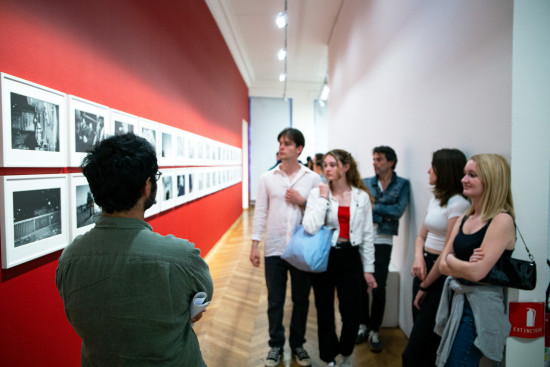
In a famous book by the American journalist Carlton Beals, The Crime of Cuba, published in 1933, photographs by Walker Evans show Cuba under the iron hand of president Gerardo Machado. Without complacency, always trying to maintain a proper distance, Walker Evans walked through the streets of Havana in search of a social and urban typology. There are portraits made in the street and photographs of buildings: advertising posters, signs, and messages printed on walls all find their place in his field of vision. By showing a large number of such signs, Evans strives to go beyond the visible surface of things, beyond their surface message. Sixty years later Angel Marcos has followed a similar path. Instead of the neutral, frontal, taxonomic inventory made by Evans, Marcos proposes a poetic and political inventory. In his large, colourful "tableaux", there are two layers of discourse: the historical dimension of the pre-Castro period, and the now outdated context of Castro's regime. Unlike in the socialist urban utopias in some Central and Eastern European capitals such as Bratislava or Bucharest, Castro did not seek to do away with the architectural heritage of Havana. Everything was preserved intact. What was built was a discourse founded on an omnipresent ideology: the walls of the old buildings were used to display slogans and political messages.

Angel Marcos's large format pictures force us to look at detail and reveal the singular insularity of Cuba, a place where time seems to have stood still and which seems somehow to have stepped out of history. It is this mute confrontation that makes the work so compelling. Real life seems to have deserted these streets and houses. They no longer ring with the laughter of their inhabitants, and death seems to have taken over the living. What makes Angel Marcos's work so strangely beautiful is that each picture is like a funeral portrait from Fayoum, calling out to us in eerie silence.

Jean-Luc Monterosso
DIrector of the Maison Européenne de la Photographie
From the catalogue Ángel Marcos, in Cuba published by the MEP in collaboration with the Naples Museum and Alcón Hotel Cutural Center, 2006.

Many thanks to the Ernst Hilger Gallery.