 |
Catherine Ikam & Louis Fléri: 'Portraits. Réel/virtuel'
In the companion text to an 1947 exhibition of his drawings, Antonin Artaud defined the human face as that which goes away; an empty force, a field of death, the old revolutionary demand for a form which has never corresponded to the body, which sets out to be something other than the body.
I find it interesting today to wonder what identity means in the electronic age, and more especially to look at notions of identity and appearance, the living and the artificial, humans and models.
What image of ourselves do we receive from the different forms of technology that surround us? In the age of virtual reality, digitalization and cloning, what happens to notions of identity and otherness? What interests me as an artist is to produce works which can express appearance as well as disappearance, sudden presence as well as absence. What interests me is:
The face as landscape
The face as territory
The face as a place of confusion
Portraits made from things that arent there.
With digital technology, the nature of the portrait changes. It is no longer the ultimate reference of identity.
I want to evoke the old technique of wax masks. What you get with a laser is quite similar: a thin, very elastic digital mould, which constitutes the raw material for the operations to come.
It is easy to modify at will the parameters of this digital face and of its environment. The usual distinction between outside and inside no longer exists. What we have is a concave portrait; the glossy texture of its skin acts like a glass wall upon which a virtual light source is reflected, creating even more distance.
The face becomes an artefact, a model that can be created and modified ad infinitum. It is no longer linked to a chemical or magnetic support (photo, film or video), and is now open to all forms of transformation. It is at once a trace, a vestige and a process.
For example, it is possible to superimpose computer-generated expressions on a face: expressions it would never have had naturally, and which are impossible to distinguish from the real thing.
An ambiguous dialectic is set up between the original and its double.
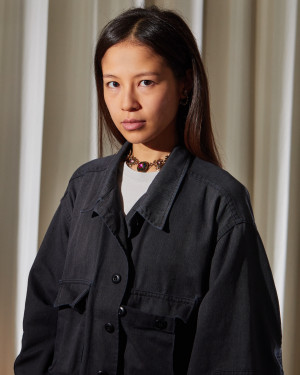
On the theme of the digital portrait, the exhibition presents paper prints, video installations and a virtual environment, made since 1997.
Catherine Ikam, 1998
A book has been published by the Maison Europèenne de la Photographie to accompany the exhibition.
Biographie
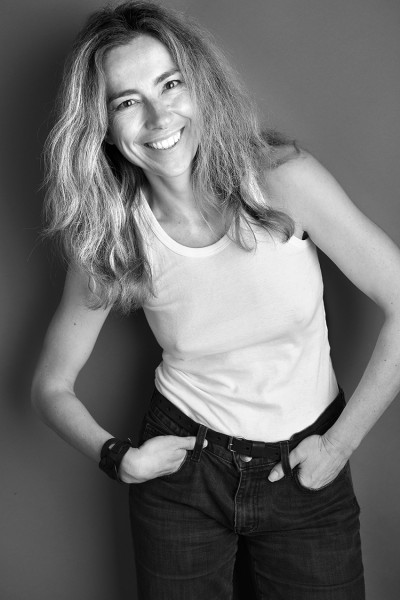
The artist Catherine Ikam was Research Fellow at the Massachussetts Institute of Technology, and has produced programmes on new tehnology for Antenne 2. She co-wrote (with Tod Machover) a video opera entitled Valis, coproduced by lIrcam and the MNAM (MusÈe National dArt Moderne) for the 10th anniversary of the Centre Georges Pompidou.
Since 1992 she has been interested in creating virtual real-time interactive environments. Working with Louis Fléri, she designed 'L'Autreî' presented for the first time in 1992 at the fondation Cartier pour l'Art contemporain, 'Le Messager', presented in 1995 at the Cités Cinés 2 show at La Défense, and 'Alex', first presented on 13th June 1996 for the inauguration of the new exhibition spaces at the IRCAM.
Le Messager and Alex combine real-time image and sound modulations. The virtual portraits first presented at the Biennale dArt contemporain in Lyon (December 1995) continue Catherine Ikams exploration of the concept of identity in the electronic age, begun in 1980 with IdentitÈ III and followed by Valis in 1987 and LAutre in 1992.
Catherine Ikam was awarded the Arts Electronica prize at Linz in 1993, and won a special award at Cyberstar, Cologne, in 1995. She has been awarded the title of Chevalier des Arts et Lettres in France.
|